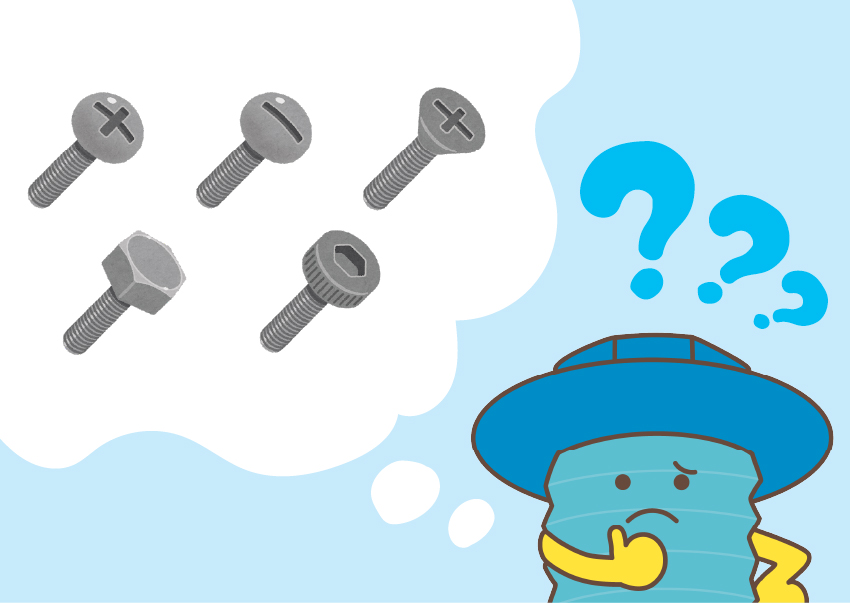

These days, screws are everywhere and so commonplace that we rarely stop to think about them or even notice them, right?
However, if you look at the things around us, it's no exaggeration to say that screws are used in all of them.
Japan’s representative industries—automobiles and game consoles—along with smartphones that have rapidly spread in recent years, computers, televisions, and essential home appliances—it's becoming increasingly difficult to find something that doesn’t use screws.
Even with today’s advanced technology, nothing has been invented to replace the screw—a device that can both connect things and loosen them.
So, let's explore when, where, and how the screw was invented.
The Beginnings of the Screw
Existing for over 2000 years?
Around 280 BCE, Archimedes' water-lifting pump reportedly utilized the principle of the screw.
A wooden pump that continuously draws water by rotating a spiral screw inside an inclined cylinder. It was used to pump water accumulated in the ship's hold and, in ancient Egypt, to draw water from the low-flowing Nile River.
Leonardo da Vinci and the Screw
Leonardo da Vinci (1452–1519) left sketches in his notebooks of the principle of screw-cutting using taps and dies. This is said to be the oldest recorded use of screws for fastening.
Japan’s History
The Arrival of Firearms and the Screw
The arrival of firearms at Tanegashima in 1543 is said to mark the first encounter between the Japanese and screws.
A Nanban ship (or possibly a Chinese vessel) drifted ashore on Tanegashima, and the matchlock guns purchased there used screws.

Japan’s Modernization and a Single Screw
Oguri Kozukenosuke, who traveled around the world as part of the Embassy to the United States, was astonished when he saw the shipyard technology in Washington up close.
He realized that Japan’s technology, in other words the nation’s strength, was far inferior to that of Europe and America. He resolved, “I want to make Japan a country that can mass-produce things like this,” and what he brought back with him is said to have been a single screw.
After returning to Japan, he devoted himself to the construction of the Yokosuka Iron Works, then worked on building shipyards. He laid the foundations for modernization through railways, newspapers, hotels, and corporations. In other words, it is no exaggeration to call Oguri Kozukenosuke a pioneer of Japan’s modernization and industrialization, and the “one screw” he brought back from America can be said to have helped advance Japan’s modernization.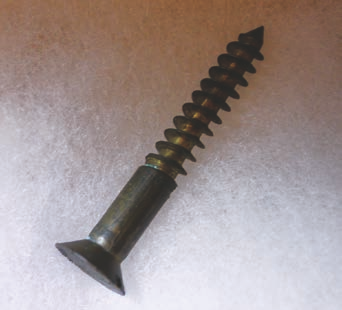
The screw Oguri Kozukenosuke brought back
“The Salt of Industry”
Did you know that the screws that supported Japan’s high economic growth are called “the Salt of Industry”?
Though plain and unobtrusive, they are said to be indispensable to industry, earning the title “Salt of Industry” due to their importance.
Screws connect things, but through those connections, things are created, and people connect through those things. The wisdom dating back to ancient times continues to this day, supporting industry.
★Click here for a list of NITTOSEIKO Screw products(industrial fasteners)